


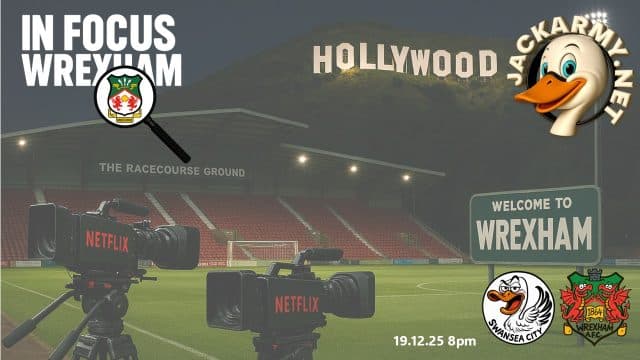
The In Focus series has always been about more than fixtures and form. It is about understanding the opposition, peeling back the layers, and seeing the game through the eyes of those who have carried their clubs through triumph and hardship. This week, the spotlight falls on Wrexham, a side whose story has become one of the most talked about in football.
For Swansea supporters, the clash is not just another date on the calendar. It is a meeting of two Welsh clubs with proud histories, each carrying the weight of expectation and the passion of their communities. Wrexham arrive with headlines that stretch far beyond the pitch, but beneath the noise lies a club with roots as deep as any in the game.
As we continue this series, the aim is simple: to give our readers a fuller picture of who we face, what they represent, and why the ninety minutes ahead matter. Football is never played in isolation. Every opponent brings with them a story, and Wrexham’s is one worth telling before the whistle blows.
Who are Wrexham
Wrexham Association Football Club is one of the oldest professional clubs in the world, founded in 1864 at the Turf Hotel in the town centre. Their home, the Racecourse Ground, is recognised as the oldest international football stadium still in use, having hosted Wales matches since 1877. For generations, the club has been a cornerstone of North Wales identity, carrying the pride of a community that has seen its fair share of hardship and resilience.
The club’s history is rich with moments that echo far beyond the town. Wrexham famously defeated Arsenal in the FA Cup third round in 1992, a shock result that remains one of the great cup upsets. They also lifted the Welsh Cup a record 23 times, underlining their dominance in domestic competition before the restructuring of Welsh football. European nights brought glamour too, with Wrexham facing the likes of Anderlecht and Porto in the 1970s and 80s, proving that even a club from the lower divisions could stand tall on the continental stage.
Their journey has not been without struggle. Financial crises and relegations tested the loyalty of supporters, yet the fan base never wavered. The supporters’ trust even took ownership in 2011 to safeguard the club’s future, a testament to the bond between town and team. Through all of this, Wrexham have remained a symbol of endurance, a club that embodies the grit of its people.
To understand Wrexham is to see more than results and trophies. It is to recognise a club that has been woven into the fabric of Welsh football for over 160 years. They are not newcomers to the spotlight, but a side whose story has always mattered, whether in the glare of Europe or the grind of the lower leagues.
Their Manager
Phil Parkinson has been at the helm of Wrexham since July 2021, guiding the club through one of the most transformative periods in its history. Born in Chorley, Lancashire in 1967, Parkinson enjoyed a long playing career as a midfielder, most notably with Reading, where he made over 350 appearances and captained the side to promotion. His reputation as a leader on the pitch carried seamlessly into management.
Parkinson’s managerial journey began at Colchester United in 2003, where he achieved promotion to the Championship. He later managed Hull City, Charlton Athletic, Bradford City, Bolton Wanderers, and Sunderland. His time at Bradford was particularly memorable, taking the club from League Two to the League Cup final in 2013, a rare feat for a fourth-tier side. At Bolton, he secured promotion to the Championship in 2017, further cementing his reputation as a manager who could build resilience and success.
Since arriving at Wrexham, Parkinson has overseen their rise from the National League to the Championship, achieving back-to-back promotions in 2023, 2024 and 2025. His tactical approach often favours a solid defensive structure with a 5-3-2 formation, balanced by attacking flair from players like Paul Mullin and Ollie Palmer. Under his guidance, Wrexham have combined Hollywood investment with grounded footballing nous, ensuring the club’s progress is not just about headlines but about results on the pitch.
Parkinson’s tenure has been marked by consistency, discipline, and an ability to harness the energy of a passionate fan base. For Swansea, facing a side led by a manager with such pedigree means preparing for a team that will be organised, resilient, and unafraid of the big occasion.
Wrexham Words
 To understand Wrexham, you have to listen to the people who have carried the club through the lean years and the glory nights. Cerys, a lifelong supporter from the town, has followed Wrexham since the turn of the century. For her, the club is not just about football, it is about identity. “I remember standing on the terraces when we were fighting for survival, not knowing if the club would even exist the next season. Those moments made us stronger. Now, seeing the Racecourse full again, it feels like we’ve come home.”
She is clear that the Hollywood story is what everyone talks about, but for her it has always been about the badge. “We’ve seen promotions, relegations, and everything in between. What matters is that Wrexham is ours, and we’ll follow them anywhere.”
These words capture the heartbeat of the club. Wrexham supporters have lived through financial crises, ownership battles, and the grind of non-league football. Yet they never walked away. Their loyalty is not performative, it is woven into their lives. For Cerys, the rise back into the Football League is a vindication of years spent believing when belief was all they had. It is proof that the club’s soul has never been lost, no matter how turbulent the journey.
When Swansea face Wrexham, they face not just a team but a community that has endured and endured again. The voice of Cerys reminds us that behind every headline lies a supporter’s story, and those stories are what make football matter.
Hollywood
The story of Wrexham’s Hollywood years began in February 2021 when Ryan Reynolds and Rob McElhenney completed their takeover of the club. The pair invested around £2 million to secure ownership, promising not only financial stability but a renewed sense of ambition. What followed was a transformation that captured global attention. Their arrival brought sponsorships, media coverage, and the Disney+ documentary Welcome to Wrexham, which showcased the club’s journey and gave fans worldwide a window into the heart of North Wales football.
The impact has been profound. Wrexham have achieved three successive promotions, climbing from the National League to the Championship in just four years. The club’s valuation has soared, recently estimated at up to £350 million, a staggering rise from the modest sum Reynolds and McElhenney first paid. Shirt sales have exploded, with over 100,000 sold annually, and the Racecourse Ground has become a destination for supporters from across the globe.
In 2024, the Allyn family purchased a minority stake, and in December 2025 Apollo Sports Capital joined as investors, further strengthening the financial base. These moves underline that the Hollywood era is not a fleeting headline but a sustained project aimed at building Wrexham into a Premier League club while investing in the local community. Plans for redeveloping the Racecourse, including a new Kop stand, are part of this vision.
For all the glamour, Reynolds and McElhenney have consistently emphasised that their commitment is rooted in the town. “From day one, we wanted to build a sustainable future for Wrexham AFC. And to do it with a little heart and humour,” they said in a joint statement. The Hollywood years have brought unprecedented attention, but at their core they remain about giving Wrexham supporters the club they deserve.
Their Season So Far
Wrexham’s return to the Championship has been anything but quiet. After back-to-back promotions, the 2025–26 campaign marks their first season at this level since the early 1980s. As of mid-December, they sit mid-table with six wins, five losses, and a string of draws that have kept them hovering just outside the playoff places. Their resilience has been clear, with a nine-match unbeaten run recently snapped by Hull City, a result that frustrated manager Phil Parkinson but underlined the competitive nature of the division.
At home, the Racecourse has been a fortress of sorts, with strong crowds averaging over 10,000 and a handful of notable wins, including victories against Bristol City and Charlton Athletic. Away from home, however, results have been harder to come by, with draws against Preston and Blackburn showing their ability to compete but also highlighting the challenge of turning stalemates into wins. Kieffer Moore has led the scoring charts with eight league goals, providing the cutting edge in attack.
The season so far has shown both promise and growing pains. Wrexham have proven they belong at this level, but consistency remains the key if they are to push into the playoff spots. As the midway point approaches, the club finds itself balanced between ambition and reality. For Swansea, this means facing a side that is battle-hardened, buoyed by momentum, and still chasing the dream of a fourth successive promotion.
The Referee
 The man in charge of Friday night’s clash at the Swansea.com Stadium will be Oliver Langford. A vastly experienced official, Langford has been refereeing in the English Football League since 2007 and has taken charge of hundreds of matches across the Championship, League One, and League Two. He is known for his calm manner on the pitch and a willingness to let the game flow, though he has not shied away from issuing cards when discipline is required.
Langford’s record this season shows an average of three yellow cards per game, with only a handful of red cards issued. He has overseen fixtures involving both promotion contenders and relegation battlers, and his consistency has earned him regular appointments in the Championship. For Swansea supporters, it is worth noting that Langford has officiated Swans matches before, including tense encounters where his decisions were tested by passionate crowds. Wrexham too have crossed paths with him in recent years, and both sets of fans will know they are dealing with a referee who has seen it all.
His assistants for the evening will be Mark Stevens and David Harrison, with Gavin Ward acting as fourth official. Together, they form an experienced team tasked with keeping order in what promises to be a fiery Welsh derby. In matches of this magnitude, the referee’s role is not just about enforcing the laws of the game but about managing emotions, tempo, and the fine margins that can decide the outcome. Langford’s steady hand will be crucial in ensuring the contest remains fair and competitive from first whistle to last.
Match Prediction
This fixture carries more weight than the average league game. Swansea come into it with a point to prove, eager to assert themselves against a Wrexham side that has captured headlines but still faces the reality of Championship football. The Swans have shown flashes of quality in recent weeks, with midfield control and pace on the flanks offering a route to unsettle Parkinson’s organised back line.
Wrexham, for their part, will lean on the physical presence of their forwards and the energy of a fan base that travels in numbers. Their resilience has been evident all season, but away from the Racecourse they have looked vulnerable when pressed high and forced into mistakes. Swansea’s ability to dictate tempo could be decisive.
It feels like a tight contest, one that will be fought in the middle of the pitch and decided by small margins. Yet with home advantage and the hunger to stamp authority in a Welsh derby, Swansea may just edge it. Prediction: Swansea City 2–1 Wrexham.
Who Are We?
As the final whistle draws near on this preview, it is worth remembering what this match represents. Swansea against Wrexham is not just another fixture in the Championship calendar. It is a meeting of two Welsh clubs whose histories are steeped in pride, struggle, and resilience. For the Swans, this is a chance to show that our identity is not defined by headlines elsewhere but by the passion of our supporters, the graft of our players, and the spirit of our city.
The call now is to everyone connected with the club. To the fans who fill the stands, to the players who wear the shirt, and to the staff who work tirelessly behind the scenes. This is a moment to stand together, to make the Swansea.com Stadium a wall of sound and belief. Welsh pride is not something to be spoken of lightly. It is lived, felt, and carried into every tackle, every run, and every goal.
Whatever the outcome, this game is a reminder of what football in Wales means. It is about community, about identity, and about the unbreakable bond between club and supporter. As we face Wrexham, let us do so with conviction, with unity, and with the knowledge that we represent more than ourselves. We represent Swansea, and we represent Wales.
This article first appeared on JACKARMY.net.