


There is something about these InFocus pieces that always sharpens the senses. Maybe it is the chance to step outside our own bubble for a moment and look across at the team waiting for us on the weekend. Maybe it is the reminder that every club carries its own history, its own bruises, its own ambitions. Whatever it is, this latest instalment arrives at a time when Swansea City are searching for a foothold in a season that has already asked plenty of questions.
Oxford United come to mind as one of those sides who never quite fit the easy labels. They are not a traditional rival and they are not a club we cross paths with every year, yet there is a familiarity to them. A sense that they have always been there in the background, working away, building something, falling apart, building again. Football is full of clubs like that and they often tell you more about the game than the giants ever will.
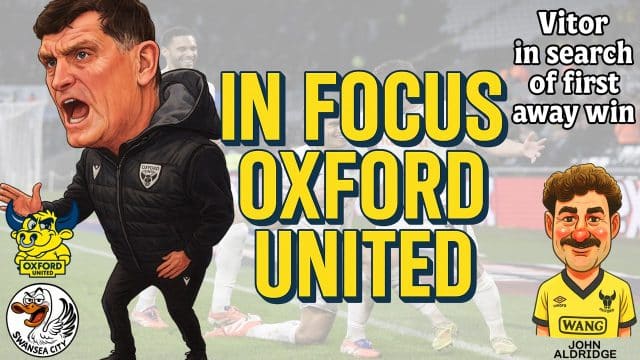
As Vitor Matos continues to shape his ideas and push for that first away win, this is a good moment to take a breath and look properly at the team standing in our way. Not just the league position or the form table but the story behind the badge. That is what this series is for and Oxford are a worthy subject.
Who are Oxford United?
Oxford United are one of those clubs whose story feels stitched into the fabric of English football even if they have spent long stretches outside the spotlight. Their roots go back to 1893 when they were founded as Headington Football Club, a team formed by local cricketers looking to stay fit through the winter months. They were very much a village side in those early years, playing on modest grounds and carrying the kind of homespun identity that defined so many clubs of that era.
The name Headington United arrived in 1911 after a merger with Headington Quarry, and for decades they worked their way through the local and regional leagues, slowly building a reputation. The post war years brought ambition and structure. They joined the Southern League in 1949 and began to grow into a force outside the Football League, winning titles and making their presence felt in the FA Cup. By 1960 the club made a symbolic shift, changing their name to Oxford United to reflect the wider city and its aspirations.
Their rise into the Football League came in 1962 after Accrington Stanley folded, opening a place that Oxford were elected to fill. From there they climbed steadily, reaching the Second Division by 1968 and establishing themselves as a competitive, upward looking club. The 1980s brought their golden era. Successive promotions carried them into the First Division and in 1986 they lifted the League Cup, the greatest moment in their history.
What followed was a long decline. Relegation from the top flight in 1988 began a slide that eventually took them out of the Football League entirely in 2006, making them the first major trophy winners to fall into the Conference. Yet Oxford have always been resilient. They fought their way back in 2010, climbed again in 2016 and in 2024 earned promotion to the Championship through the play offs, a reminder that their story is still being written.
They remain a club with a proud identity, a fierce rivalry with Swindon Town and a fanbase that has carried them through every rise and fall. Oxford United are proof that history is not just about the trophies. It is about the journey.
Their (temporary) manager
Oxford United arrive in this fixture under the guidance of Craig Short, a man who has become something of a familiar figure at the Kassam. He is not the headline name some clubs turn to in a crisis, but he is the steadying presence Oxford always seem to call upon when the ground beneath them starts to shift. This is his fourth spell as caretaker manager, which tells its own story about trust, continuity and the respect he holds inside the building.
Short stepped in again after the dismissal of Gary Rowett, who left the club following a poor run of form that had dragged Oxford back toward the relegation places. The message from above was clear. He would take charge for the visits of Southampton and Swansea, and possibly the trip to Ipswich, giving the club breathing room while they search for a permanent successor.
His first game back in the hot seat brought a 2–1 win over Southampton on Boxing Day, a result that lifted spirits and nudged Oxford out of the bottom three. Short spoke afterwards about the emotional swing of the day, admitting he felt the pressure beforehand but was euphoric by the end. He described himself as a safe pair of hands, someone there to steady the ship and grab a few points while the club works out its next step.
Short has been part of the Oxford coaching staff since 2020 and has managed elsewhere with Ferencvaros and Notts County. He knows the rhythms of the club, the personalities in the dressing room and the expectations of the supporters. He is not in the running for the permanent job by his own admission, but he is exactly the kind of caretaker who can make a team awkward to play against. Swansea will know better than to underestimate him.
From the eyes of an Ox
To understand a club properly you need to hear from the people who live it. Not the pundits or the passing observers but the ones who have stood on cold terraces, watched the false dawns, celebrated the rare highs and carried the weight of the lows. For Oxford United, Simon fits that mould. He has followed them since the turn of the century and speaks about the club with the kind of affection that only comes from years of sticking around when it would have been easier to walk away.
 When I asked him what Oxford means to him, he paused before answering. “It’s never been simple with us. We’ve had the glory stories from the eighties thrown at us for years, but most of my time supporting Oxford has been about survival, rebuilding and hoping for something better. That’s what binds us. We’ve lived through the hard bits together.”
He talks about the club’s identity with a quiet pride. The years in the Conference still sting, but they also shaped the way Oxford fans see themselves. “We were the first major trophy winners to drop out of the league. That hurt. But it also made us tougher. You learn who you are when you’re playing at places you’ve only ever seen on a map.”
Simon is honest about the present too. The return to the Championship brought excitement, but the season has been a grind. “We’re not pretending to be something we’re not. We know we’re fighting. But we’ve got players who care and a fanbase that won’t let the club drift.”
When the conversation turns to Swansea, he is respectful. “You lot play football the right way. Always have. Even when things aren’t going well, you try to do it properly. I respect that. But we need points and we’ll make it awkward for you.”
There is no bravado in his voice, just the realism of someone who has seen enough football to know that nothing is ever guaranteed. Oxford fans like Simon carry their club with a mixture of hope and caution. It is a combination Swansea will recognise all too well.
The League Cup win – triumph but rewards denied
Every club has a moment that stands above the rest, a day supporters carry with them for the rest of their lives. For Oxford United, that day came on 20 April 1986 at Wembley Stadium when they lifted the League Cup after beating Queens Park Rangers 3–0. It remains their only major honour and it is spoken about with a reverence that tells you everything about what it meant to the club and the city.
The run itself was impressive. Oxford entered the competition in the second round and saw off Northampton Town over two legs, winning 4–1 on aggregate. They then beat Newcastle United 3–1 at home, followed by another 3–1 victory against Norwich City, the holders at the time. Portsmouth were next, and again Oxford won 3–1. The semi final brought a two legged tie with Aston Villa. A 2–2 draw away set things up for a decisive night at the Manor Ground where Oxford won 2–1 to book their place at Wembley.
The final is etched into Oxford folklore. Trevor Hebberd opened the scoring just before half time, settling nerves and giving the Yellow Army belief. Ray Houghton added a second early in the second half, and Jeremy Charles wrapped it up late on after following in a saved effort from John Aldridge. Ninety thousand people were inside Wembley that afternoon, with an enormous travelling support making the short journey from Oxford. It was the club’s first live televised match and the scale of the occasion was unlike anything they had experienced before.
There is a bittersweet footnote. Because of the ban on English clubs in European competition, Oxford were denied a place in the UEFA Cup the following season. Even so, nothing can take away the achievement. For a club that had climbed from the Southern League to the top flight in little more than two decades, that day at Wembley remains the pinnacle.
Their season so far
Oxford’s second year back in the Championship was always going to reveal who they really are at this level. The first season after promotion is often fuelled by adrenaline and momentum, but the second is where the league starts asking harder questions. Oxford have found that out quickly. They have spent much of the campaign in and around the relegation places, never quite able to build the kind of rhythm that lets a club breathe in this division.
The decision to part ways with Gary Rowett was a sign of how restless things had become. Performances had flattened, goals were becoming scarce and the table was beginning to tighten around them. Craig Short stepping in as caretaker has brought a small lift. His Boxing Day win over Southampton nudged Oxford out of the bottom three and reminded supporters that the squad still has enough about it to compete. But the truth is that the margins remain thin.
Oxford have struggled to control matches for long spells. Too often they have been chasing games rather than shaping them. Their defensive record has been inconsistent and their attacking output unpredictable, which is a dangerous mix in a league where momentum can swing in a single week. They are not cut adrift and they are not without hope, but they are firmly in the group of clubs who know that every point matters.
As we edge toward the midpoint of the season, Oxford look like a side still trying to establish themselves properly at this level. For Swansea, that makes them awkward. Teams fighting for air rarely make life easy.
The man in the middle
 The referee for this one is Adam Herczeg, a Durham official who has been steadily climbing the ranks and is now becoming a familiar name across the EFL. He has been refereeing since he was 15 and is part of the PGMO Development Group, the pathway usually reserved for officials with long term potential. He took charge of his first Championship fixture in March 2024 and has adapted quickly to the pace and physicality of the division.
This will be the second time Herczeg has overseen a Swansea City match. The first came in the home win over Norwich City, a game where he kept a calm handle on proceedings and avoided inserting himself into the spotlight. That is generally his approach. He is not a referee who tries to shape the rhythm of a match. He prefers to let the football breathe, stepping in only when the temperature rises or when a decision simply has to be made.
Across his 14 EFL games this season he has shown 56 yellow cards and two reds, numbers that place him somewhere in the middle of the pack. Not overly strict, not overly lenient. For a game like this, where both sides will be desperate for control and momentum, that balance might suit Swansea. Vitor Matos wants his team to play with tempo and bravery, and a referee who allows the match to flow can help that.
Herczeg will be assisted by Andrew Fox and Shaun Hudson, with Andrew Kitchen acting as fourth official. It is a crew with enough Championship experience to manage the occasion without fuss. Oxford’s home crowd can be lively when they sense an opportunity and Swansea’s travelling support will bring their own energy. Herczeg’s job will be to keep the match steady when the emotions rise. He has shown he can do that.
How we see it
There is no hiding from the importance of this game. Swansea need an away win to settle the nerves and give Vitor Matos something solid to build on. Performances have improved in spells, but football is a results business and the table does not wait for anyone. Oxford, for their part, are fighting for every scrap they can get. A team in their position rarely rolls over at home and the Kassam can be an awkward place when the crowd senses vulnerability.
This feels like one of those matches that will be decided by patience. Swansea will want the ball, will want to dictate the tempo and will want to pull Oxford into uncomfortable areas. The question is whether they can turn that control into chances and whether they can stay switched on when Oxford inevitably throw bodies forward. There is enough quality in this Swansea side to win the game, but they will need to be ruthless in both boxes.
Oxford will make it physical. They will try to break the rhythm and feed off any frustration. But if Swansea stay calm and trust the patterns they have been working on, there is an opportunity here. It might not be pretty, and it might not be comfortable, but it feels like a match Swansea can edge.
Prediction: Oxford United 1 Swansea City 2
Who are we?
As we head into this one, there is a sense that Swansea are standing at a small but meaningful crossroads. Performances have shown signs of life, ideas are beginning to take shape and the players look like they are starting to understand what Vitor Matos wants from them. But football does not reward promise on its own. It rewards conviction. It rewards the moments when a team decides that enough is enough and that the season will not drift any further.
Oxford away is not glamorous and it is not easy, but it is exactly the sort of fixture that can shift the mood of a campaign. A win here would not solve everything, but it would give Matos something solid to build on. It would show that the work on the training ground is beginning to translate into something real. It would remind the players that they are capable of more than the table currently suggests.
And this is where the supporters come in. The away end has always been the heartbeat of this club. Through the lean years, the long trips, the cold nights and the false dawns, Swansea fans have carried the team with a stubborn kind of loyalty. That matters. It matters to the players, it matters to the staff and it matters to the identity of the club.
So as we head to the Kassam, let’s bring that noise, that belief and that sense of togetherness that has defined Swansea City for generations. Let’s back the manager as he searches for his first away win. Let’s back the players as they fight for every inch. And let’s back the badge, because it has carried us through far tougher moments than this.
There is still a season to be shaped. It starts with nights like this.
This article first appeared on JACKARMY.net.