


Swansea City walked out of The Den with a 2–1 defeat that felt like a punch to the ribs, not because they were the better side over ninety minutes, but because of how close they came to turning a bruising afternoon into something far more meaningful. The scoreline tells one story. The performance tells another. And the comments afterwards from both dugouts reveal even more about where Swansea are heading.
The opening half was a struggle. Millwall came out with a ferocity that felt like a team playing for something bigger than three points. You could sense it in the stands and you could see it in the way they pressed, harried and forced Swansea into mistakes. One voice in the tunnel afterwards summed it up bluntly: “The game should have been two or three up at half-time.” It was hard to argue. Swansea were pinned back, unable to build through midfield, and repeatedly rescued by Lawrence Vigouroux, who produced a series of saves that kept the match alive.
Vitor Matos didn’t sugarcoat it. “We were not able to find our momentum or consistency with the ball,” he said, reflecting on a first half where Swansea looked like a side still adjusting to the demands of a new identity. He spoke about the intensity they faced and the difficulty of establishing any rhythm. It was honest, and it was accurate.
But football matches are rarely defined by one half, and Swansea’s response after the break was the clearest sign yet of what Matos is trying to build. The second half was played with purpose, aggression and belief. Swansea stepped higher, moved the ball quicker and began to win duels they had been losing earlier. Within minutes they were level, Ben Cabango reacting sharply to Jay Fulton’s flick to silence The Den and shift the momentum.
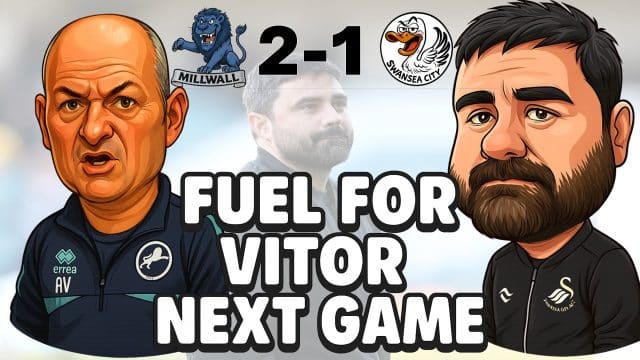
Matos saw exactly what the supporters saw. “The second half was completely different,” he said. “The willingness to push the game was there on our side.” He talked about the need for more energy and intensity and how the players responded to that challenge. And then came the line that will probably follow Swansea into the next few weeks: “We need to use that as fuel for the next games.”
Fuel. Not comfort. Not excuses. Fuel.
Even the opposition bench acknowledged the shift. One comment stood out: “They forced themselves back into the game. They were hungrier, snappier with the balls that dropped.” That kind of respect doesn’t come easily at The Den. Swansea earned it.
The frustration, of course, is that the fightback didn’t lead to a point. Championship football is unforgiving, and late lapses are punished. Swansea switched off at the death, Caleb Taylor rose highest, and the match was gone. A harsh ending, but not an unfamiliar one for a team still learning how to manage tight moments.
Yet even in defeat, there were performances that underline Swansea’s direction. Vigouroux was exceptional. Matos called him “outstanding” and said he was one of the main reasons Swansea stayed in the game. That barely captures it. His saves weren’t routine. They were interventions that changed the emotional temperature of the match. Without him, the second‑half fightback never happens.
Cabango’s leadership was clear. Fulton’s relentlessness knitted the midfield together. Ronald offered flashes of threat even when Swansea were under pressure. And perhaps most importantly, the collective refusal to fold after a bruising first half showed a mentality that hasn’t always been present in recent seasons. Swansea sides of the past have sometimes drifted through games once the tide turned against them. This one didn’t.
Still, the gaps are obvious. Swansea struggled to play through Millwall’s press. They were too passive early on. They didn’t manage the final minutes with the composure required. These are not small issues, and Matos knows it. But they are also the kind of issues that can be corrected with time, clarity and repetition. That is the reality of a team in transition.
The opposition manager framed the win as a test of character. “Have you got enough bottle, enough drive, enough grit to get that next goal that matters?” he asked. Swansea will need to answer the same question in the weeks ahead. Not because they lack those qualities, but because they are still learning how to summon them consistently.
And that is the real context of this defeat. Swansea are not chasing the play-offs like Millwall. They are building something. They are trying to establish a style, a mentality, a rhythm. There will be setbacks along the way, and this was one of them. But the second half showed a team that can grow, a team that can adapt, a team that can fight back in difficult circumstances.
Matos’ message afterwards wasn’t about excuses. It was about trajectory. About taking the good from the second half and refusing to let the late goal define the performance. About using the frustration as motivation rather than weight.
Swansea supporters know the difference between a team that is drifting and a team that is developing. This one, for all its flaws, is clearly the latter. The challenge now is to turn those 45‑minute performances into 90‑minute ones. To turn resilience into control. To turn promise into points.
The Den delivered a harsh lesson. But it also offered a glimpse of what Swansea can become if they keep pushing in the direction Matos is pointing them. And in a season of transition, that matters as much as the result.
This article first appeared on JACKARMY.net.
1 reply
Loading new replies...
Michu
Join the full discussion at the Welcome to the Lord Bony Stand →